
The Cyentia Institute started the “Ripples Across the Risk Surface” series with RiskRecon by Mastercard way back in 2019. The series analyzes #cybersecurity incidents that spill over to affect multiple organizations via #thirdparty and #supplychain connections (aka “ripple events”).

Most security professionals are well aware that these ripple events are common occurrences and a side effect of the highly interconnected, interdependent business environment in the digital age. But many may not be aware of how the costs of such incidents are shared among the parties involved and how these costs are changing over time. We’ll highlight both in this post, which summarizes findings from the latest Ripples Across the Risk Surface report (https://www.cyentia.com/publication/2025-ripples-across-the-risk-surface/)
Let’s start with some terminology that is necessary to interpret these findings. We refer to the original or primary victim of the ripple event as the “generator.” All other organizations impacted by that original event are “receivers” of the ripple effects. These ripples take many forms, from intrusions that propagate across trusted third-party connections to service outages that impact dependent organizations to financial losses that flow to downstream partners.
The chart below compares reported financial losses for single-party incidents (regular events that impact only one organization) vs. losses incurred by the generating organization of a multi-party incident vs. losses to downstream organizations impacted by those events (receivers).

It’s not surprising to see that generators of multi-party incidents tend to incur more losses than receivers. But you may be surprised to learn that organizations on the receiving end of ripple events have significantly higher losses than typical for single-party incidents (median of $1.8M vs $470K). Let that sink in for a moment: Ripple events are more costly to individual firms—even those impacted downstream—than single-party incidents.
Ripple events are more costly to individual firms—even those impacted downstream—than single-party incidents.
Ok, so how are costs to generators and receivers of ripple events changing over time? Since we’ve been doing this research for a while now, we finally have enough data to answer that important question. The scatterplot below charts reported losses over the last 15 years and shows the trend for both generators and receivers.
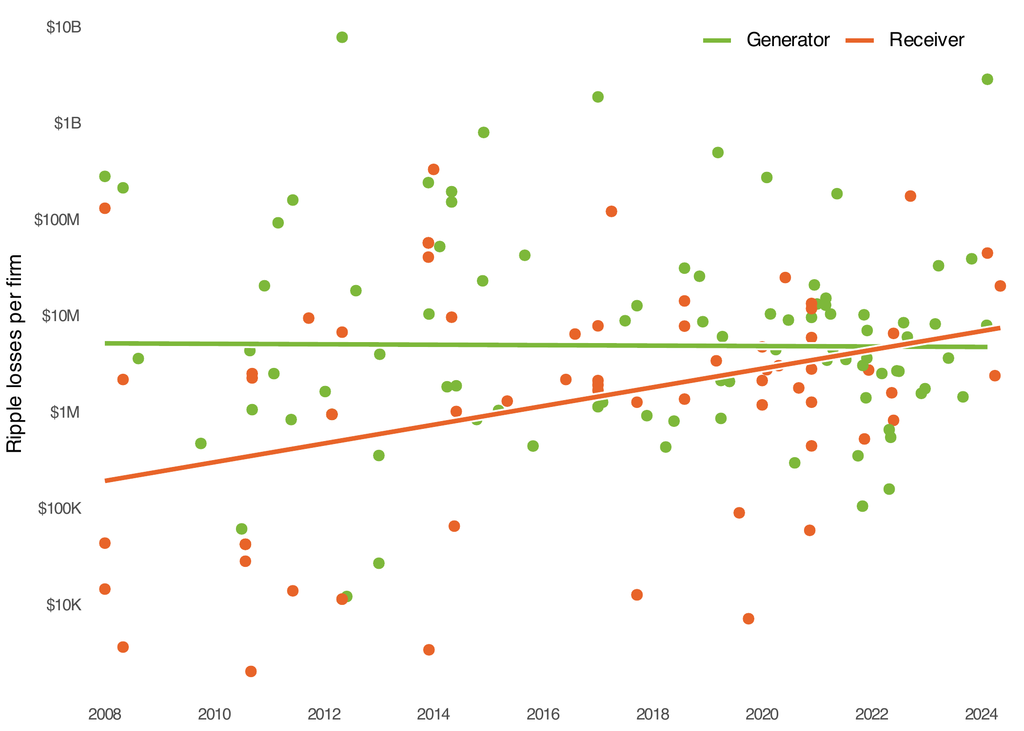
While there’s a ton of variation among reported losses for each group, the trend is pretty clear. Over time, the per-firm costs of ripple receivers have been increasing and are now roughly equal to those of generators. This highlights the increasing dangers faced by firms of being caught up in an incident involving another party and brings us full circle back to the title of this article: Your third party’s breach costs as much as your own.
Losses from ripple events are trending such that they’re now the same for generators and downstream receivers.
Looking for data-driven insights to help manage risk for ripple events? Download the 2025 edition of Ripples Across the Risk Surface here: https://www.cyentia.com/publication/2025-ripples-across-the-risk-surface/