
In case you haven’t heard, we recently released an AI research assistant for our members; check out the announcement here.
Cyentia has always been in the business of clearing the brush—trying to cut through the noise in cybersecurity to share insights that actually hold up. So when we started designing our AI research assistant, it felt pretty natural that we didn’t want it to invent anything. We knew we wanted it to stay close to the evidence, same as we try to do.
That instinct has a practical consequence. Ask it about something we haven’t studied—who will win the World Series, which memecoin to buy—and it will tell you, earnestly and with a straight face, that it has absolutely no idea.
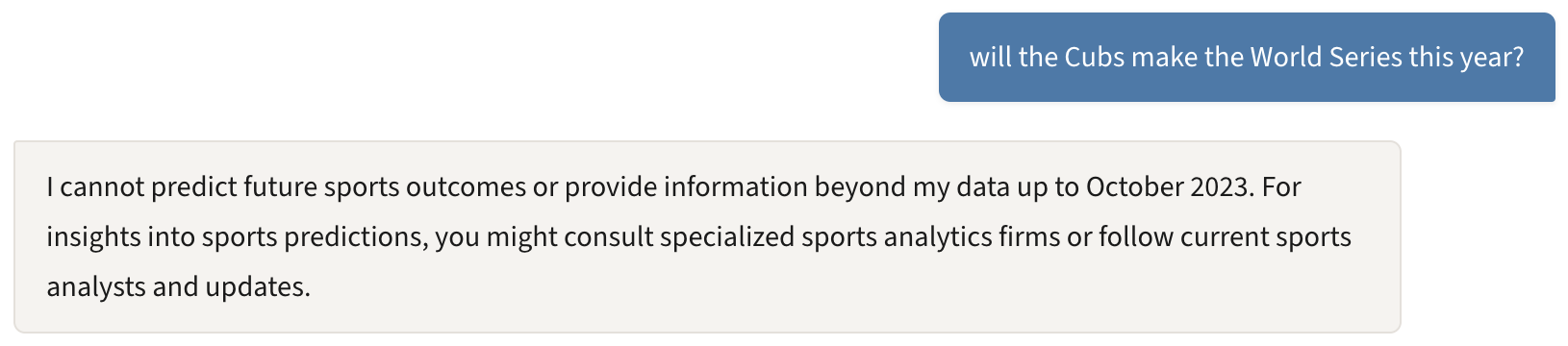

Not because it couldn’t generate something that sounds like an answer. It absolutely could. But a confident-sounding answer you shouldn’t trust is worse than no answer at all.
Ask it something we have studied, though, and you get a different experience entirely.
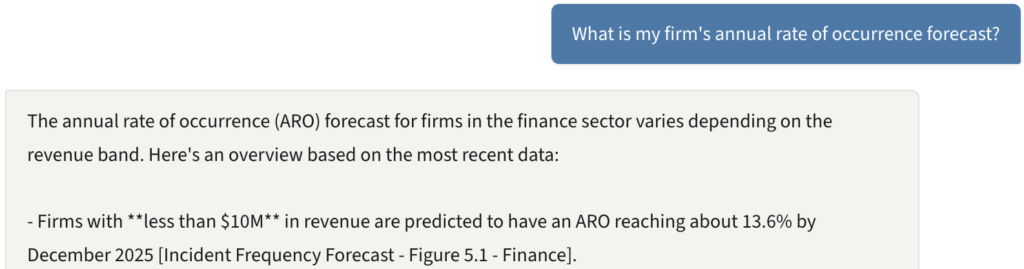
This is the part that might surprise folks, but we hope not. When the assistant tells you it can’t answer something from the available research, that’s actually useful information—it means the question is genuinely outside what Cyentia has been able to rigorously analyze. Not just outside what’s been written about generally, but specifically outside our evidence base1. A tool that always produces an answer buries that distinction. (And in a field where confident assertions that don’t survive scrutiny are already endemic, that seems like exactly the wrong direction to go.)
We’d make this design choice again. The value of our research depends on the same discipline: cite your sources, quantify uncertainty, don’t assert what the data doesn’t support. An assistant that borrowed the Cyentia name while quietly operating on different rules would undermine the whole point of what we’re doing here.
The hardest thing to build into an AI system isn’t capability. It’s knowing when not to use it—and on that front at least, we’ve got you covered.
¹ At least for now, the assistant draws from our IRIS and Retina research library. What it knows in the future is another question entirely…